Documentation for Substance 3D bakers is now available on Experience League. After March 14th, HelpX pages will automatically redirect to the equivalent Experience League page.
Refer to the FAQ for more information about which documentation is affected.
Last updated on
Sep 17, 2025

- Substance 3D home
- Home
- Getting Started
- Bakers settings
- Settings overview
- Common Parameters
- Ambient Occlusion
- Ambient Occlusion from Mesh
- Bent Normals from Mesh
- Color Map from Mesh
- Convert UV to SVG
- Curvature
- Curvature from Mesh
- Curvature from Mesh (deprecated)
- Height Map from Mesh
- Normal Map from Mesh
- Opacity Mask from Mesh
- Position
- Position map from Mesh
- Thickness Map from Mesh
- Transferred Texture from Mesh
- World Space Direction
- World Space Normals
- Guides
- Features
- Common questions
- How to export the baked maps?
- Is dithering applied to baked textures?
- Should I enable "Compute tangent space per fragment"?
- What are Assbin files?
- What is the bit depth of baked textures?
- What is the difference between the OpenGL and DirectX normal format?
- Why are there strange stretches in my textures after baking or exporting?
- Why is Matching by Name not working with Ambient Occlusion/Thickness?
- Why is my mesh fully black after baking?
- Common issues
- Aliasing on UV Seams
- Baker output is fully black or empty
- Baking failed with Color Map from Mesh
- Black shading cross are visible on the mesh surface
- Mesh parts bleed between each other
- Normal map has strange colorful gradients
- Normal texture looks faceted
- Seams are visible after baking a normal texture
- Seam visible on every face
- Texture baked outside of Substance software looks incorrect
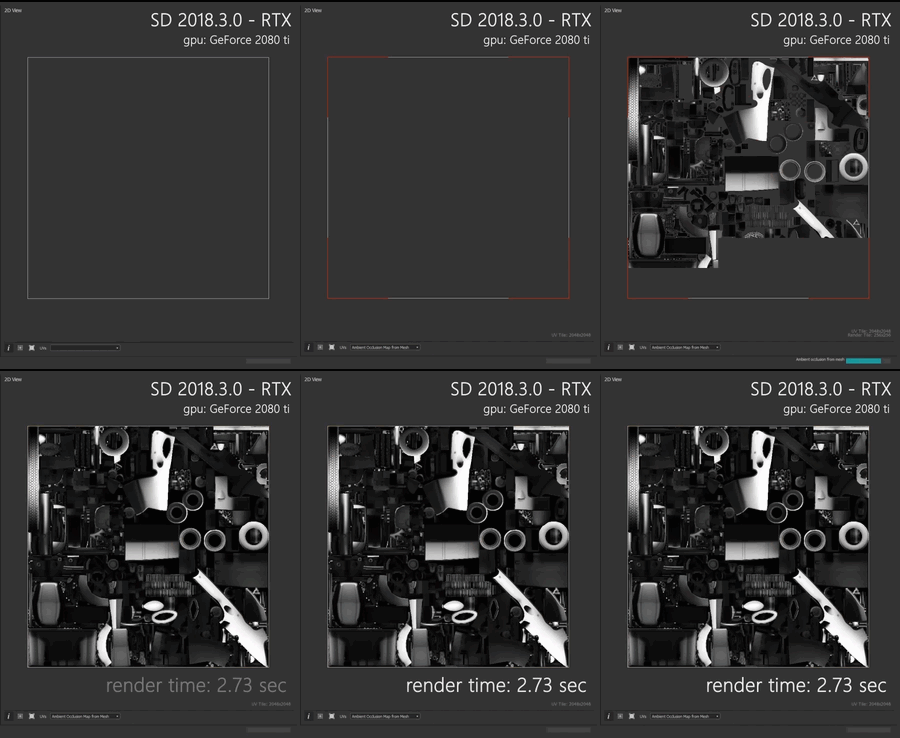
Some bakers support hardware acceleration of raytracing on the GPU, which usually increases computation speed by a factor of 25 or more.
Hardware requirements
Ray tracing will automatically be enabled if the system follows these requirements:
- A compatible GPU is installed* (RTX series, Titan V or GeForce 10xx)
- GPU drivers are up to date
- Windows 10 'Fall Creator' / October update (ver 1809) or higher is installed**
*: Compatible NVIDIA GPUs include all GPU using the Pascal architecture or more recent. I.e., the GTX 10 series, Titan V series, RTX 20 series, or more recent.
**: To check your Windows version, click on the Start menu, type 'winver' and press Enter.
You can get the update through the dedicated page on the Microsoft support website.
Tip
In case you run into issues, GPU raytracing can be disabled in the application preferences.
Supported bakers
The tables below lists GPU raytracing support for every baker, according to the Substance 3D bakers version:
|
Baker |
Supports GPU raytracing |
|---|---|
|
Ambient occlusion |
|
|
Bent normal |
|
|
Color |
|
|
Curvature |
|
|
Height |
|
|
Normal |
|
|
Normal world space |
|


|
Baker |
Supports GPU raytracing |
|---|---|
|
Opacity mask |
|
|
Position |
|
|
Position low |
|
|
Thickness |
|
|
Transferred texture |
|
|
World to tangent |
|
|
Baker |
Supports GPU raytracing |
|---|---|
|
Ambient occlusion |
|
|
Ambient occlusion from mesh |
|
|
Bent normals from mesh |
|
|
Color from mesh |
|
|
Convert UV to SVG |
|
|
Curvature from mesh |
|
|
Height from mesh |
|
|
Normal from mesh |
|
|
Baker |
Supports GPU raytracing |
|---|---|
|
Opacity mask from mesh |
|
|
Position from mesh |
|
|
Position |
|
|
Thickness from mesh |
|
|
Transferred texture from mesh |
|
|
World space direction |
|
|
World space normals |
|
*: Supports CPU raytracing, which is significantly slower than GPU raytracing.
